How We Teach

Encourage Curiosity

Motivate By Guiding Children To Ask Real, Meaningful Questions About the World First - Then Help Them Discover The Answers

Full of energy, a three-year-old never stops exploring, bombarding her parents with “why’s” from the moment she wakes until her final nighttime breath. Eager to finally be a big kid, a first-grader looks forward to his first day of school, and to begin the quest of elementary learning. Young children are innately curious. They implicitly understand that they need to learn in order to act, in order to live: they see that adults can do things they are not yet able to do, and they are motivated to acquire the independence of adults. They want to learn about the world and acquire the skills they need to act in it.

At LePort, we recognize this natural tendency. Our goal is to motivate our students by transferring their natural curiosity about the world into an academic setting. We aim to make sure that our students’ thirst for knowledge is satisfied by their school experiences. We want to keep your three-year-old’s genuine interest in the world alive, so that as a 14-year-old leaving us in eighth grade, she remains as excited about learning, in school and outside, as she was at the beginning. This is what we mean by our slogan, “Knowledge for Life”.

At LePort, we motivate by the “detective story principle”: we start with the child’s natural desire to learn, and appeal to that desire by presenting, at the start of a lesson, material that raises a question in the child’s mind. Once we have awakened his curiosity, we then present him with the content of the lesson – content he is eager to understand and apply because of the way it has been presented to him.

The question comes first, the content, second. In math, we puzzle the student by asking students to calculate “5+10*3” – and some come up with 35, some with 45 as the answer. Students are puzzled – and ready to discuss the rules for stipulating which order of operation is correct. In history, we ask them to think about their favorite things – foods, places, friends, clothes – and then ask them what would make them give all of those up. This sets the scene for discussing the asceticism of medieval monks, and their motivation for giving up all worldly goods.

More fundamentally, we motivate by ensuring that each student is sincerely interested in what we teach, so that he chooses to engage based on the content of our lessons, and not artificial promises of rewards or threats of punishments. We also don’t appeal to mere novelty; at LePort you won’t see ancillary hands-on projects without clear learning goals. Our emphasis on content-based motivation begins in Montessori, when children have a lot of choice in the work they do from preschool and into elementary; in literature, where we offer fascinating stories that draw the children in; in grammar, where we make diagramming sentences a fun game between two groups of students.
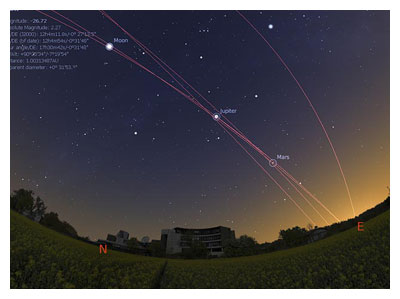
Why in the world would 5th graders care to learn about the “retrograde motion of planets”? At LePort, we teach astronomy by starting with observations – first, of stars and planets in the night sky which students log, then by letting them work with Stellarium, an online planetarium software. We ask them to log Mars’ position on the night sky, first by going outside for several nights, then, on an accelerated time line, within Stellarium.

We start the observations with time periods where Mars moves from west to east against the background of the stars, as planets do most of the time. After several exercises logging this movement, however, something strange happens: Mars moves from East to West – it has reversed direction! Our students are puzzled: they verify their work, and find the same result. They come to their teacher, and wonder if the Stellarium software has a bug, or if they made a mistake in their work. Our teacher tells them to just note their observations until the next astronomy class – by which time they are more than eager to learn about the retrograde motion of planets, and its role in the discovery of the heliocentric explanation of our solar system by Copernicus.

Teach Sequentially

Knowledge For Life Means Learning About The World - Not Repeating A Teacher's or Textbook's Mere Assertions

At LePort, our goal is to teach knowledge, not hearsay. In order for your child’s mental content to truly be knowledge, he must be able to do more than repeat a claim—he must know why the claim is true. “Why”, in this context, means that the child can trace the chain of knowledge all the way back from an abstract concept or idea (such as “plants release oxygen during the process of photosynthesis”) to the observational evidence needed to arrive at that conclusion (which often comes in multiple steps, such as “there are different types of materials in the world, such as rock and wood and water”, “some materials are solids, some are gases”, “plants don’t need foods the way animals do”, and “a candle burns longer when it is in a container with a green plant.”) When the child really understands, he knows the sequence of facts that demonstrate the truth of a given idea – as against just citing a book or a teacher’s authority.

At LePort, we want children to understand the world so they can act in it; memorized chains of words or symbols are not knowledge, and undercut motivation. We offer our students systematic, sequential instruction – so they can build knowledge upon knowledge, and always know why they are learning something, and how it ties to the world. This is what makes learning motivating: being able to understand the world! Floating constructs – such as having to memorize the process of photosynthesis, without understanding what it really is and why it matters – is what turns eager learners into reluctant students. What could be more boring than being asked to memorize “2n CO2 + 2n H2O + photons → 2(CH2O)n + n O2 + 2n A” – without understanding why the process described by this equation even matters?!

Dr. Montessori once described the difference between someone who learns through a systematic process as against someone who amasses disconnected information as the difference between a cabinet with file folders and a grab bag full of stuff. Our role as educators is not just to ensure that children acquire lots of information – but also to provide them with the proper hierarchy for that information, so that our students can call upon that knowledge, retrieve it easily, and apply it in practice. And that, after all, is our overall goal: Knowledge for Life – knowledge to enable mind-guided action.

We respect the proper cognitive sequence in each subject. For example:

  • Language Arts: We explicitly teach writing skills, step-by-step – before we expect students to do complex writing that requires the application of those skills.

  • Mathematics: In Montessori, children learn concrete, simple operations, such as 4x7, first with concrete manipulatives (the Bead Materials), then abstractly (pencil & paper), then progress to more complex operations (such as 1,276 x 42, first with manipulatives such as the Checkerboard, then abstractly.)

  • Science: Our program progresses from observation to classification to theory development. (The latter re-traces, where appropriate, the discovery process of the great scientists, who had to learn the knowledge through observation and inference, and not from authority.)

  • History: We teach history chronologically (as against the typical California approach of starting mid-stream, without context, with California History in Grade 4.)

  • Literature – we always offer great works of art, and sequence them in line with the child’s growing mental powers: from the best children’s novels (e.g., The Indian in the Cupboard by Lynne Reid Banks in 4th grade), to accessible plays (e.g., The Miracle Worker by William Gibson), to literature with increasingly broad themes and advanced language (e.g., starting with Macbeth by William Shakespeare in 6th grade, and moving to The Count of Monte Cristo by Alexandre Dumas by the end of 8th grade.) Throughout, we also integrate literature with history, paralleling in our choices the child’s progression from ancient to modern history.

A Personal Touch

Learning is Each Individual Child's Job - And He Can Only Do That Job If He Can Tie What He Learns To His Context of Background Knowledge, Skills and Interests

At LePort, the child’s choice to learn is central to our approach: real learning (as against just memorizing, or engaging in “hands-on projects” without further meaning) has to build upon sincere interest by the child. You can make a child memorize historic events; you can make him build a diorama of a historic scene – but you cannot make him understand what made the Declaration of Independence the tremendous achievement it is. In order to do the latter, he must exercise his choice to engage his mind.

To engage the child’s interest, we take his full context into account: his background knowledge, his skill level, his values and interests.

A student who comes to us with a weakness in math facts will struggle in class – unless we offer him dedicated tutoring to remedy his unique skill gaps. A creative child who loves writing, but lacks organizational skills, will fail in writing class – unless we provide her with extra coaching on project planning and time management. A child who has experienced history at another school as dry recitation of dates and figures will need our teacher’s extra effort in tying the historic events he studies to his own world.

The general principles of encouraging curiosity and teaching sequentially are the foundation for making learning enjoyable. But we do more: we personalize your child’s learning experience in many ways. For example:

  • In our Montessori classrooms, a child is free to choose from developmentally appropriate education materials, guided by her own interests, and can progress through the curriculum at her own pace.

  • In our elementary and junior high program, we tie what we teach to the children’s context. For example, when we talk about asceticism in history class, we begin by asking students what they value, what they are most passionate about in the world – foods, sports, friends, experiences – then ask them to imagine what would make them give up all these values.

  • In each class, we tailor assignments to the different levels of skills of students (from offering additional practice to more challenging assignments.)

  • We offer individualized academic and organizational/executive functioning coaching outside of class, tailored to target a student’s specific challenges.

  • With STAS, LePort’s in-house, individualized curriculum and tutoring program, students can thrive at our school whether they are far behind or far advanced. We offer one-on-one or small-group instruction instead of regular classes, for an additional fee, and thus tailor our instruction to a wide range of abilities. (This is especially important in mathematics, where ability levels diverge significantly by 4th or 5th grade.)

Apply Through "Work"

We Develop Mastery and a Growth Mindset Through Applied “Work”

At LePort, knowledge is ultimately a means to action, to pursuing goals and interests – it is not something stale to stuff in a student’s brain for a test, only to forget it right after.

To keep knowledge meaningful and fun, we create real application opportunities in each subject, all the time.We are deliberate with the exercises we create: applying knowledge happens when students have to think about the content; thus, our exercises are not “popsicle stick” projects, or papier-mâché dioramas – but require real intellectual work.

This is very obvious in our Montessori program: the lesson the teacher gives only provides the initial impetus for the real learning, which happens during the child’s independent work with the educational material. As he orders color tablets by their shades, as he uses the bead stair to teach himself addition, as he traces sandpaper letters over and over again, the child is working: he is concentrating in the pursuit of his goal, namely, mastering a new skill he is interested in.

As our students progress, their work becomes more mental and less physical – but it is meaningful work just the same. In vocabulary class, our students write creative stories with vocabulary words, and actively use their minds (as against passively checking off multiple-choice answers.) In mathematics, our students learn concepts – and apply them in increasingly challenging word problems (as against mechanistically reproducing process steps.) In literature, our students draw implications from what they read, and write essays comparing characters and their choices across novels (as against merely retelling a story’s plot.)

Throughout, we create applications that engage the children’s minds on the topic they are learning: they think about the content we want them to remember, and thus make the knowledge their own. Contrast this to many of the “hands-on projects” found in other schools: making a diorama of an icy world with penguins may be fun, but unless it is a carefully crafted expression of a deeper intellectual lesson, does little to stimulate thinking about what living in Antarctica means.

Because we expect each student to apply himself, to revise his work, to develop his skills, and because we emphasize that success is within his control, our approach helps students develop a mastery-focus and a growth mindset. Our students aren’t discouraged by a bad performance or a low grade – they persevere, because they have learned that with effort, they canmake good things happen.

Prepared Environment

Creating an Environment That Facilitates a Child's Choice To Work

At LePort, we deliberately design a whole environment that facilitates each child’s choice to learn, and to develop into a mature, independent person. We start with the physical environment: we offer safe, clean classrooms, attractive facilities, nice outdoor spaces and play areas, and good educational materials.

Our deliberately designed environment also includes a wide range of intangibles – the rules, policies, people and ideas a child experiences are each designed carefully to support our mission of equipping our students with Knowledge for Life. Our sequential selective curriculum, and our unique teaching approach are a key part of this environment.

Other examples include:

  • The prepared environment of our Montessori classrooms in preschool and in grades 1-3. From the child-sized furniture, to the self-correcting materials; from the child’s ability to choose his work, to his choice of mats or table and work partners; from the plants and animals in the classroom, to the type of teachers we hire and their comportment: everything is tailored to help the child choose to learn and to concentrate on productive work and personal development.
  •  

  • Our supervised, controlled environment at recess. Our teachers participate and coach students not just in class, but also during recess. We help them by providing clear rules – such as “no reading during recess” or “no running up stairs” – and consistent, predictable and helpful consequences (such as walking back down and up the stairs if students forget the rules.) By participating and controlling the environment, we transform recess from a chaotic free-for-all filled with peer-pressure – to a benevolent opportunity for developing personal and social skills.
  •  

  • Our systematic integration of organizational and time management skills into the everyday classroom experience. We don’t leave the development of practical skills to chance – or rely on individual teachers to come up with their own systems (which would lead to different classes having different systems, confusing the child—as happens in most schools). At LePort, we have created a coherent system, which all teachers and students use, and which gives children successively more freedoms and less guidance. From daily sign-offs of assignments, to longer-term deadlines, to finally the earned freedom from adult supervision once students master their planner habits: our environment is set up to enable our students to grow and to thrive later on in the less-controlled spheres of high school and college.